As it turns out, I've not only landed in a place that's beautiful and amazing and full of cool wildlife, but I'm also lucky enough to have met people here who love nature and are willing to go on adventures with me!
During Labor Day weekend, I got to visit Montezuma National Wildlife Refuge -- a swampy area at the north end of Cayuga Lake that's especially important for migratory birds -- with one of my new colleagues and his wife who happen to be very experienced local birders. Montezuma was wonderful, with plentiful habitat for shorebirds and other water-loving creatures, and with my companions' help I was able to pick out new-to-me birds like Pectoral Sandpipers and Stilt Sandpipers from among the flocks of other similar-looking species milling around the fields and ponds. (The real test will be whether I can identify those birds again on my own later! We'll see!)
A Ruddy Turnstone was drawing a small crowd of admirers as it foraged near the road (apparently these birds are relatively infrequent passers-by in this area):
A Greater Yellowlegs was foraging nearby, looking positively lanky next to the primarily smaller shorebirds in the area:
We saw quite a few juvenile Common Gallinules on the water:
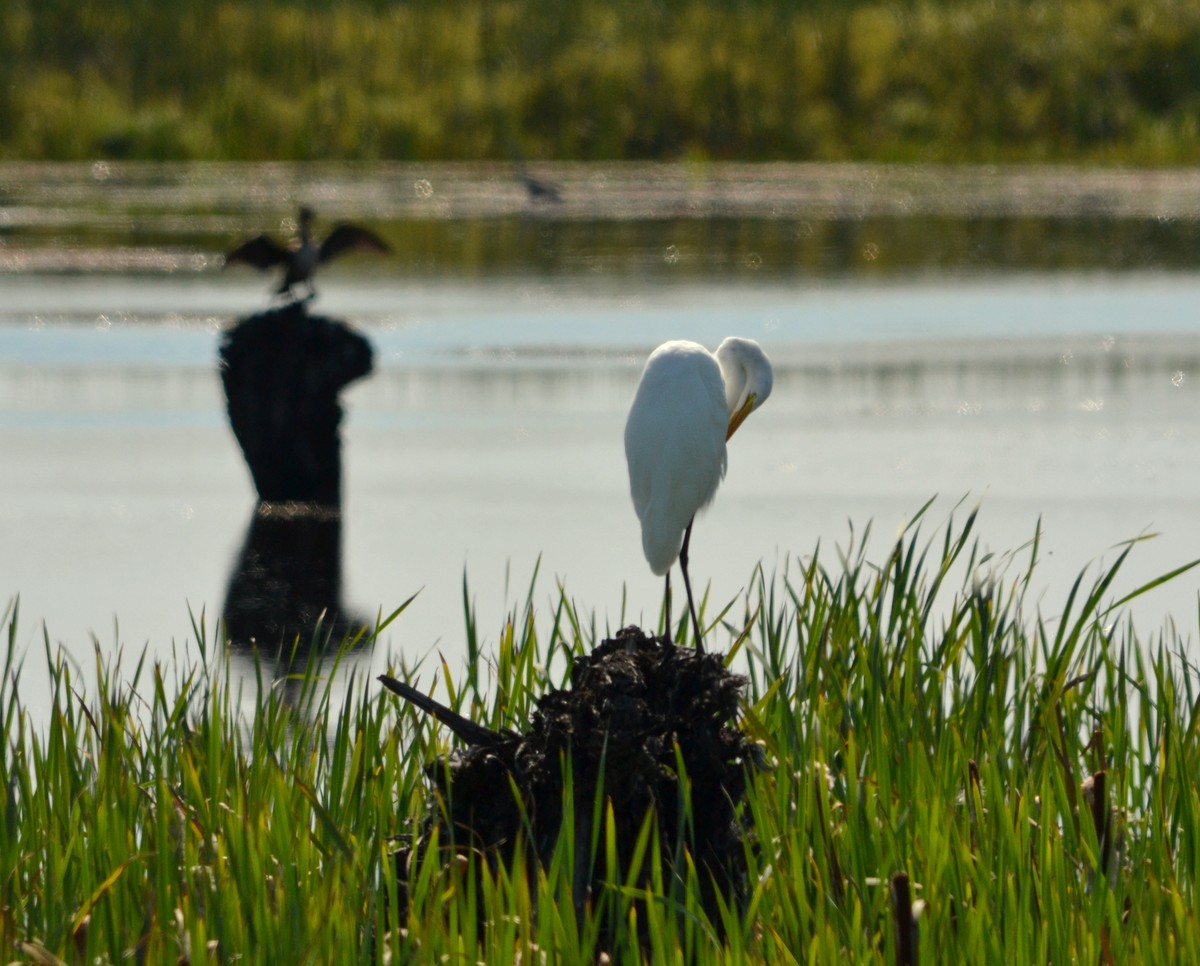
And I couldn't resist this image of a preening Great Egret with a Double-crested Cormorant drying its wings in the background:
A pair of Sandhill Cranes apparently nests every summer at Montezuma, and I so wanted to see these birds (if they hadn't yet left for the year). I have practically no experience with cranes, which makes them almost mythical creatures as far as I'm concerned. Well, we were driving by some fields near the refuge, and then there were four tall gray/brown figures moving through the grass, like deer but not:
The parents are the gray birds with red masks, and the juveniles are the browner ones with plain faces. And now I know that baby cranes are called "colts," and it is the most wonderful thing:
The Sandhill Cranes were a highlight, but the whole trip to Montezuma NWR was awesome. It's a bit of a drive to get to this place from Ithaca, but I'm sure I'll be back to experience Montezuma in its various seasons!
Then last Sunday, I went on a walk with a small group of colleagues at the Lindsay-Parsons Biodiversity Preserve, a Finger Lakes Land Trust preserve just south of Ithaca. We were absolutely the only people in this place the whole time we were there. We walked in woods, around ponds, and through the most perfect, rolling, goldenrod-filled fields, and it was wonderful:
Beavers had flooded an area of these woods in recent years, leaving a big swampy stand of dead trees:
We saw a bunch of Wood Ducks swimming among the skeletal trunks and brush, but they stayed well away from my camera's reach.
I have missed Red Efts a whole lot in my year away from the east, and I was so happy to find them here in these rain-dampened woods. We counted 11 of these wonderful creatures just along the path; how many more were out wandering through other areas of the forest?
A fancy Scalloped Sallow moth (Eucirroedia pampina) sat in what looked like a headstand on a milkweed leaf:
I started feeling a hint of Fall during that walk (!), and I'm happily anticipating the cool, crisp weather and wonderful Fall sights to come. I'll close with my phone's view of the goldenrod fields at Lindsay-Parsons, all blue sky and yellow flowers and a ribbon of green (soon to be orange/red/yellow!) trees:
I visited the Arcata Marsh last Saturday (May 7) and again on Monday, curious to see how the place is changing as spring progresses. I am sorely missing my familiar eastern spring migration, and I haven't found anything so dramatic here, but there is certainly seasonal change. And there were plenty of May-ish things to see at the marsh!
Big purple lupine blooms (I'm not entirely sure of the species) filled big patches of field near the paths:
On Sunday, I saw a Green Heron keeping watch over a rather precarious-looking nest:
And I watched an adult Orange-crowned Warbler gathering caterpillars and other goodies:
While its frumpy fledgling waited in the bushes (look at that stump of a tail!):
Monday afternoon was sunny and warm, and a Red Admiral was out and about:
These two dragonflies were gearing up to produce the next generation; they flew around a lot while interlocked like this, which strikes me as quite a feat:
Dozens of Cliff Swallows were swarming around and under the eaves of a building near the bay. This must be a good nesting place! I love watching swallows in any situation, but it was especially cool to see all these birds in one place, and to watch the patterns of their shadows on the bright wall:
Here's a video of the Cliff Swallows swooping and swarming:
Great Egrets adorned rocks in the bay:
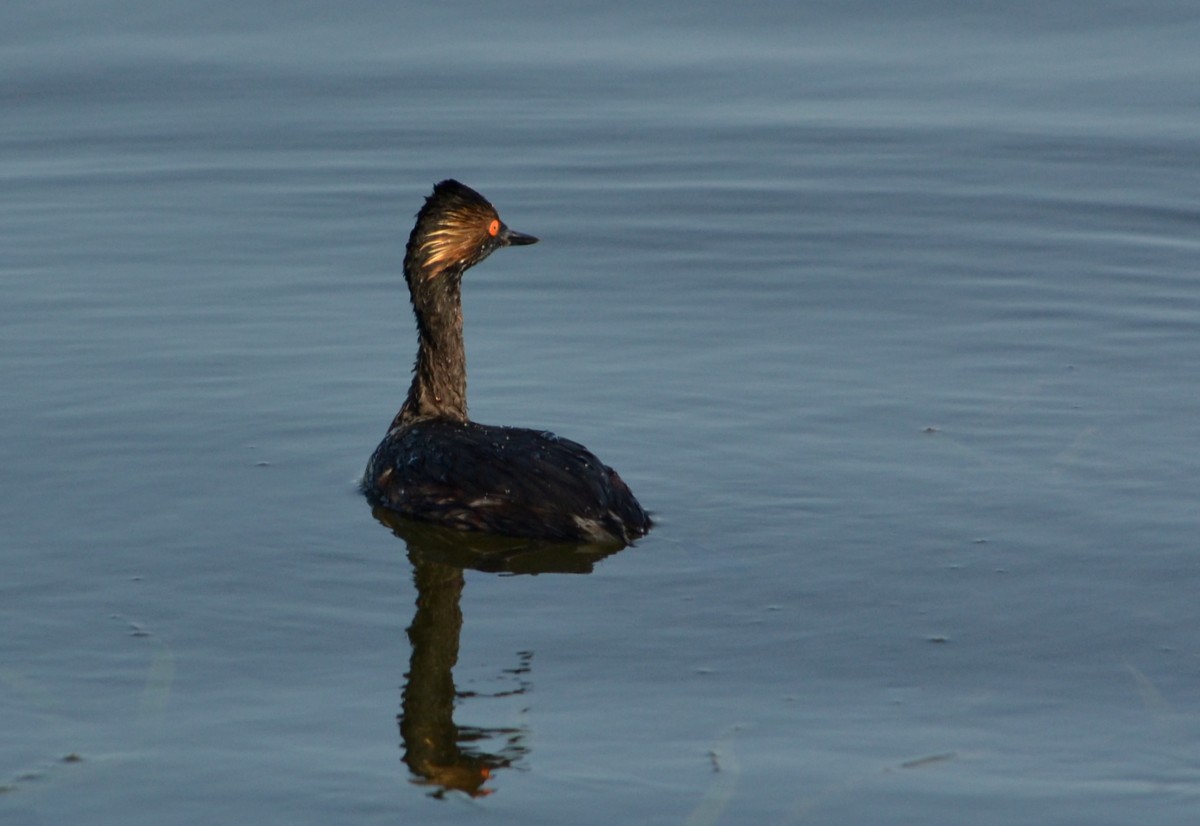
In a nearby pool, an Eared Grebe hunted over (I think) an eelgrass bed:
I've only seen Eared Grebes before in their plainer winter costumes, and I'm really liking this individual's fancy bronze face-tufts:
The coolest part, though, was seeing what the grebe brought up from underwater. I'm not sure what this little morsel is, but it looks soft and shiny:
At one point the grebe brought up a pipefish, a fish in the same family as seahorses, and certainly not a creature I've ever seen in the wild before:
I think I can see the seahorse resemblance from this angle:
The pipefish was quite a big catch for a little grebe, and it took some struggling, but the grebe finally worked the pipefish down, head first and tail waving:
Toward the end of the afternoon, I watched a male Allen's Hummingbird doing his absolute best to impress a female. Here's the male (I'm identifying him as an Allen's Hummingbird because of the green feathers on his back, although it's not impossible that he's actually a similar looking Rufous Hummingbird, since those birds are also in this area now):
And here's the discerning female:
The male would alternate between perching, feeding, and performing aerial acrobatics that involved swoops and dives and whistlesof air through his feathers. At one point I watched him dance back and forth in the air right in front of the female's face, dazzling her with his fancy feathers and fancy moves. (I really should have thought to take a video.) All of this took place in the middle of a huge and blooming blackberry patch; the plentiful flowers clearly made this an attractive spot for the hummingbird pair:
Here's the male again:
I only got to see the full effect of his costume a few times, but those moments made quite an impression!
While I was watching the hummingbirds, a male Common Yellowthroat popped out for what is surely the closest and clearest view I've had of these usually secretive birds:
I'm sure it wasn't a coincidence that I was standing in a blind at the time. What a gorgeous creature!
Nests, courtship, flowers, babies.... That sounds like May to me!
Last Saturday, Paul and I found ourselves awake unusually early, and we went for a walk at the Arcata Marsh before breakfast. I was expecting to find an extraordinary amount of dawn-time activity, but the marsh was just as active as I usually see it (which is to say, very active). Even so, it was cool to see some creatures in their morning routine. A couple of male Buffleheads were rolling onto their backs in the water and preening their pristine white bellies. I've never seen ducks do this before, and this just won Buffleheads several more cuteness points in my mind (they were already pretty cute to begin with):
Saturday's early morning light wasn't great for picture-taking, but I was back at the marsh on Tuesday afternoon when there were just as many creatures to see (with better light to see them by). Song Sparrows were singing and setting up territories along almost every stretch of the path:
And of course Marsh Wrens were all over. Little wren, does your tail get any higher?
Hundreds of shorebirds were flocking in the mudflats, and one Marbled Godwit (with a strangely crooked beak) was foraging right next to the path:
A group of five Great Egrets looked particularly fancy surrounded by mud:
This Canada Goose seems to have found a great nesting place on top of an old (redwood?) trunk with great marsh views:
A White-tailed Kite was hovering over the meadow, watching for furry morsels below:
I'm super impressed by the hovering skills of these raptors:
Yesterday morning -- again, during a temporary break in the rain -- I went back to the Arcata Marsh. I'm finally starting to take advantage of how close I live to this amazing place! Just like last week, the marsh was hosting lots and lots of ducks, as well as various other birds, including several hunters in a large pool that must have been brimming with fish. I loved getting to see herons and grebes at work, especially at such close range. (I don't know whether it's because of the abundance of wildlife or the abundance of people that hang out in this relatively small area, but the birds at the Arcata Marsh seem especially willing to stay near the paths even when people walk by!)
Two gorgeous Western Grebes were popping in and out of the water:
This grebe is about to slice into the water for another dive:
I've only ever seen these big grebes from afar before, so this was quite a treat. What a bird:
I can't get over those red eyes, and that knife-like beak:
Two smaller Eared Grebes were hunting in these waters as well. OK, wait, these eyes are the best, with that ring of yellow in the middle of the orange-red:
One of the two Eared Grebes was looking especially fluffy, but it was doing just as much diving as its fellow:
A Great Blue Heron and a Great Egret were prowling nearby:
And this turned out to be an amazing chance to watch a Great Blue Heron at work up close. First, I just had to admire this giant bird:
Herons look so funny from the front, but I absolutely love the patterns on this creature's neck and chest:
This heron proved to be an excellent hunter, nabbing a fish every few minutes. (The Great Egret wasn't having quite as much success.) Got one:
Ah, too many eyes!
And down it goes! (Not shown: the fish was still wriggling as it was swallowed.)
And there's another fish soon afterward:
So yeah, I would not want to be a fish in this pond, that's for sure.
In another pond, Green-winged Teal were busy filtering food from the water's surface, motoring around like flat little boats:
A few Lesser Scaup (including some dapper males this time) were in another pond:
And a very sleepy Horned Grebe was floating around as well:
(I also saw a Pied-billed Grebe, making a total of four grebe species; not bad for one visit!) I can't help taking more pictures of Marsh Wrens when these handsome little birds keep popping up right next to me:
Sing, little Marsh Wren!
I wonder if these birds have started building nests yet, or if they're still working on establishing their territories:
Lovely little bird:
Could this be the same Northern Harrier that flew past me last week, in exactly this same spot?
A Red-shouldered Hawk watched a meadow from a nearby tree:
And a flock of Golden-crowned Sparrows waited calmly in some brambles for me to walk past so they could return to feeding in the path:
And all that in a short visit between rain storms! Hooray for the Arcata Marsh!